Porosus is widely considered the finest crocodile leather in the world. So why do houses like Hermès sometimes choose Nile crocodile instead? The answer is more nuanced than most people expect.
Key takeaways
- Porosus is the rarest and most prestigious: its distinctive scale pores, perfect symmetry, and softness place it at the top of the exotic leather hierarchy.
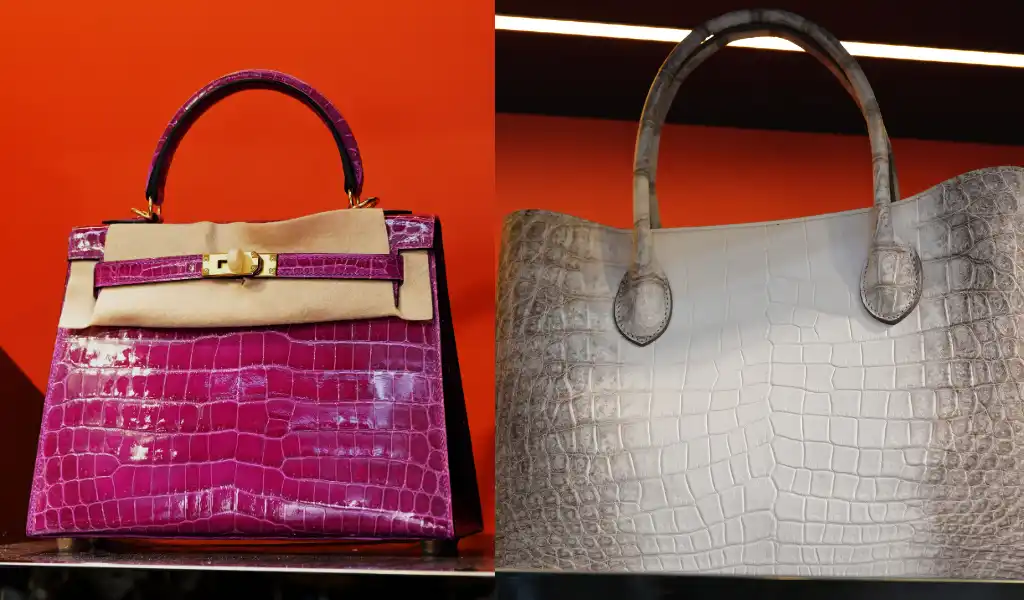
- Nile crocodile leather has a decisive advantage in tanning: its superior receptivity to dye and bleaching makes it the preferred choice for complex colour treatments like the Himalayan Birkin.
- Neither is simply better: they serve different purposes, the choice between Porosus and Nile crocodile leather depends entirely on the application.
- Both are extraordinarily expensive to farm: territorial behaviour means individual enclosures for each animal, driving costs far above any other farmed leather species.
- Both are CITES-regulated: legitimate pieces in either leather come with full documentation tracing the hide to a licensed, ethical source.
Porosus
Saltwater Crocodile
- Native to Australia, SE Asia, India
- Distinctive pore on each scale
- Perfect bilateral symmetry
- Rarest and most expensive
- Best for: handbags, prestige pieces
Nile Crocodile
Crocodylus Niloticus
- Native to sub-Saharan Africa, Nile region
- Square-shaped scales, no pores
- Slightly more supply available
- Exceptional tanning receptivity
- Best for: complex dyed pieces, Himalayan Birkin
Why Porosus Sits at the Top
Porosus crocodile leather earns its status as the rarest and most prestigious exotic leather for three reasons that work together.
First, each scale carries a small, distinctive pore, a natural feature unique to the species that gives the surface an unmistakable depth and texture. Second, the scale pattern runs with near-perfect bilateral symmetry along the belly, making it exceptionally well-suited to the precision demands of luxury bag construction. Third, the leather itself is notably soft for a crocodilian hide, far more supple than its durability would suggest.
As a result, Porosus crocodile leather commands the highest prices in the exotic leather market, and the limited supply, driven by strict CITES regulations and the territorial nature of the animal, keeps it that way.
Why Nile Crocodile Has a Unique Advantage
Nile crocodile leather is often positioned as the second-tier option, but that framing misses the point entirely.
While it lacks the distinctive pore of Porosus, Nile crocodile leather has its own set of qualities that make it irreplaceable for specific applications. The scales tend toward a cleaner, more square geometry. The skin is marginally softer still. And crucially, Nile crocodile leather accepts the tanning process with exceptional consistency.
That last quality is decisive. When a house like Hermès needs to achieve a precise, complex colour, such as the white-to-grey gradient of the Himalayan Birkin, the ability of the leather to absorb dye evenly and predictably becomes the most important factor. In that context, Nile crocodile leather is not the second choice. It is the right choice.
The Himalayan Birkin’s extraordinary colour treatment demands a hide that responds to bleaching and dyeing with near-perfect consistency. Nile crocodile leather’s superior tanning receptivity is precisely why Hermès reaches for it, not because Porosus is unavailable, but because Nile performs better for this specific application.
The Cost of Raising Either Species
Both Porosus and Nile crocodile are exceptionally large animals, reaching 15 to 17 feet in length at full maturity.
Both are also intensely territorial. Consequently, they cannot be farmed in communal pens like mink or foxes. Each animal must be housed in its own enclosure throughout its life, making the per-animal farming cost significantly higher than for any other commercially farmed leather species.
That cost, built into every hide before a single cut is made, is one more reason why both Porosus and Nile crocodile leather remain at the very top of the exotic leather price hierarchy.
So Which Is Better?
For prestige, rarity, and the finest handbags: Porosus crocodile leather is the answer. Its scale, pores, symmetry, and softness are unmatched.
For complex colour work and dyed statement pieces: Nile crocodile leather is the superior choice, and the one the world’s most demanding luxury houses reach for when precision matters most.
Both are extraordinary. The difference lies in what you need the leather to do.
Summary
Porosus crocodile leather has long held the top position in the exotic leather hierarchy, prized for its symmetry, distinctive scale pores, and extraordinary softness. Nile crocodile leather, on the other hand, offers a slightly different set of qualities that make it the preferred choice for specific applications.
Neither is simply better than the other. Rather, the two serve different purposes at the very top of the luxury market, and understanding the difference helps explain some of the most important choices made by the world’s leading leather houses.
Interested in pieces crafted from Porosus or Nile crocodile leather? The J&A team in Hong Kong works with both — with full CITES documentation on every piece. Reach out to explore the collection.