
The story of crocodile leather is one of the most remarkable transformations in fashion history, from battlefield utility to the most expensive material in any luxury house’s repertoire.Lorem ipsum dolor sit amet, consectetur adipiscing elit. Ut elit tellus, luctus nec ullamcorper mattis, pulvinar dapibus leo.
Key takeaways
- Crocodile leather began as a purely functional material: its earliest use was in military boots during the American Civil War, valued for durability above all else.
- Artists drove the first transformation: the 1920s and 1930s saw crocodile leather shift from workwear to wearable art, as designers discovered its distinctive visual character.
- Luxury houses set the quality standard: Hermès, Gucci, and their peers elevated crocodile leather into a prestige material with global demand and rigorous grading from the 1950s onward.
- Regulation made the industry stronger: CITES and ethical farming didn’t diminish crocodile leather’s value; they gave it traceable, legitimate provenance that underpins its premium pricing today.
- Alligator and Porosus are the benchmark species: their scale symmetry and hide consistency make them the most sought-after crocodile leathers in the world, and their protected status reflects that importance.
1800s: A Material Built for Survival
The earliest commercial use of crocodile leather had nothing to do with luxury. In the 1800s, it was prized exclusively for its extraordinary durability, a material tough enough to withstand the harshest conditions that standard leather could not. American soldiers wore crocodile leather boots during the Civil War precisely because the hide could endure what other materials could not. It was workwear at its most extreme, functional, rugged, and entirely without pretension. The idea that this same material would one day sit inside the world’s most exclusive boutiques was not yet imaginable.
1920s–1930s: Artists Discover Something Beautiful
The transformation of crocodile leather from utility material to desirable object began in the roaring twenties. American and European artists and designers, drawn to the visual distinctiveness of the scale pattern and the material’s natural depth, began incorporating crocodile leather into bags, shoes, and accessories for the first time. This was the decade that separated crocodile from its purely functional past and introduced it to the world of aesthetics. The exotic texture, unlike anything produced by a domestic animal, gave crocodile leather a visual language that proved immediately compelling to creative minds.
1950s–1980s: Luxury Houses Claim It as Their Own
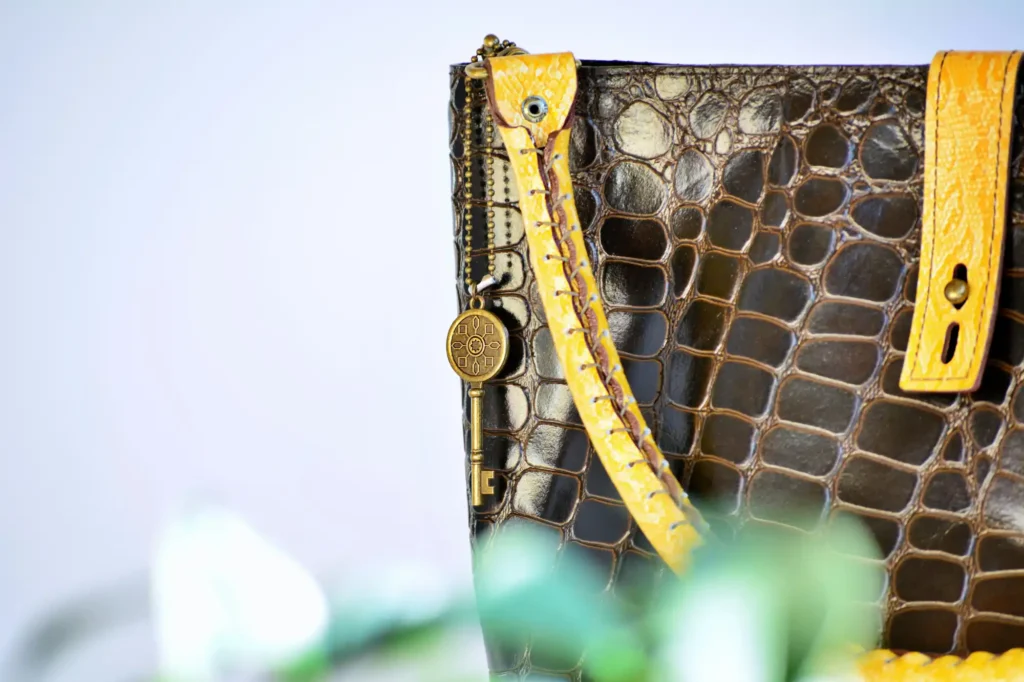
The mid-century decades were when crocodile leather made its definitive entry into the world of high fashion. Houses like Hermès and Gucci recognised the material’s potential and began producing crocodile leather goods with the same standard of craft they applied to their finest European leathers. This period elevated crocodile from a curious exotic material into a genuinely prestigious one, with quality standards, grading systems, and a global market developing around it. By the time the 1980s arrived, crocodile leather was firmly established as the material of choice for buyers who wanted something beyond what conventional luxury could offer.
1970s onward: Regulation Saves the Industry and the Animal
The booming global appetite for crocodile leather in the 1970s created a serious and urgent problem: unregulated hunting was pushing several crocodilian species, most critically the American Alligator and the Saltwater Porosus Crocodile, toward extinction. Regulators on both sides of the Atlantic recognised that without intervention, the industry would destroy the very resource it depended on.
The response was transformative. Strict hunting regulations were introduced, followed by the development of ethical farming programs that allowed crocodile leather production to continue sustainably. Most significantly, CITES, the Convention on International Trade in Endangered Species, was extended to cover crocodilian hides, creating the international certification framework that governs the crocodile leather trade to this day. Far from damaging the industry, regulation gave it a foundation of legitimacy and traceability that has made crocodile leather more valuable, not less.
Why Alligator and Porosus Crocodile? Both species are considered the gold standard of crocodile leather due to the exceptional symmetry of their scale patterns and the consistency of their hide quality, properties that make them uniquely suited to the precision demands of luxury craftsmanship. Their protected status under CITES is both an ethical necessity and a quality guarantee.
Summary
Today, crocodile leather is synonymous with the very top of the luxury market, Hermès Birkins, Gucci accessories, and bespoke pieces that command prices few other materials can approach. But the origins of crocodile leather could not be more different. It began as a purely functional material, valued for its toughness rather than its beauty. Over two centuries, through the hands of artists, fashion houses, and eventually regulators, crocodile leather was transformed into what it is today, a material with a history as rich and layered as the leather itself.