
The Himalayan Birkin is widely considered the most valuable handbag in the world. But what most people believe about how it’s made is wrong, and the truth is far more remarkable.
Key takeaways
- The Himalayan Birkin isn’t made from albino crocodile: Hermès uses Niloticus hide and achieves the white colour through a precise, high-risk bleaching process.
- The bleaching process permanently risks the hide: chemical imprecision destroys the skin entirely, meaning many hides are lost for every successful one.
- The grey gradient is applied entirely by hand: every Himalayan Birkin is a unique, one-of-a-kind piece as a result of this manual process.
- Only 1 in 20 to 50 pelts qualify: pattern and colour matching requirements eliminate the vast majority of hides before a bag can even be started.
- The price reflects everything you never see: rejected hides, failed bleaching attempts, and hours of artisan grading are all embedded in the final cost of every Himalayan Birkin.
First, the myth worth correcting
The Himalayan Birkin’s white gradient appearance leads many to assume it comes from an albino crocodile. In fact, Hermès uses Niloticus Crocodile (Crocodylus niloticus) — one of the most prized crocodilian species for its scale symmetry and hide quality. The white colour is not natural. It is achieved through an extraordinarily precise chemical treatment applied by Hermès artisans, which is itself one of the primary reasons the Himalayan Birkin is so rare.
1. The Bleaching Process Is Irreversible and Unforgiving
To achieve the Himalayan Birkin’s signature white base, Hermès artisans bleach the Niloticus hide using a carefully controlled chemical process that removes the natural pigmentation from the leather. However, this process carries a permanent risk: the same chemicals that strip the colour can also irreversibly damage the crocodile skin’s structure if applied with any imprecision. As a result, a significant number of hides are rendered unusable in the process. Every Himalayan Birkin that succeeds represents multiple hides that did not.
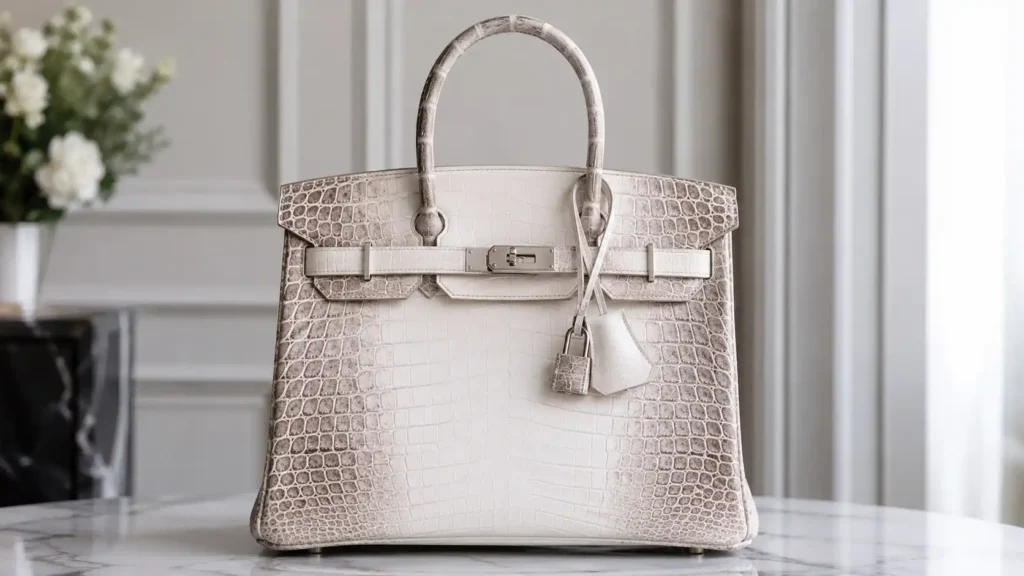
2. The Gradient Is Hand-Applied, Every Time
What makes the Himalayan Birkin visually distinctive is not just the white — it is the subtle grey gradient that fades from the edges inward, evoking the snow-capped slopes of the Himalayas. That gradient is applied by hand. Furthermore, a protective finish is layered over the entire surface to seal both the bleached base and the applied colour. Each stage must be flawless — because at this price point, and with this level of expectation, anything less means the piece cannot leave the atelier.
Select
Top-grade Niloticus hide chosen
Bleach
Chemical treatment removes natural pigment
Gradient
Grey tones hand-applied to edges
Seal
Protective finish layered over entire surface
3. Pattern and Colour Matching Eliminates Most Pelts
Beyond the treatment process itself, the Himalayan Birkin faces a third layer of difficulty that compounds everything above it. Every Niloticus hide has a unique natural scale pattern. When constructing a bag, those patterns must align seamlessly across every panel — and on top of that, the hand-applied gradient must flow consistently across multiple hides as though they were one. Consequently, only pelts whose natural pattern and colour response to bleaching align closely enough to match can be used together. In practice, that means finding perhaps 1 in 20 — or even 1 in 50 — pelts that qualify. The Himalayan Birkin, therefore, is not simply a very expensive bag. It is the visible result of an enormous invisible selection process.
At 1-in-50 pelt viability, producing a single Himalayan Birkin may require evaluating dozens of hides before the right combination is found. Each rejected hide represents real cost — in material, time, and artisan labour — that never appears on the price tag but is entirely embedded in it.
Summary
The Himalayan Birkin is not made from albino crocodile — it starts as a standard Niloticus hide and is transformed through one of the most demanding dyeing, bleaching, and grading processes in all of luxury craftsmanship. The result is a bag so difficult to produce consistently that only a fraction of pelts ever qualify. Combined with Hermès’s brand legacy and artisan skill, that scarcity is precisely what makes the Himalayan Birkin the most expensive handbag ever sold at auction.