Crocodile leather commands the headlines, but for many connoisseurs, alligator leather is the preferred choice. Smoother, more symmetrical, and more accessible in price, here is what sets it apart.
4 min read | Alligator Leather | Exotic Leather | Buying Guide
Summary
In the world of exotic leather, crocodile skin tends to receive the most attention. But spend time with serious buyers, and a different preference often emerges; many choose alligator leather not as a compromise, but as a deliberate first choice.
The reasons are specific and grounded in the material itself. Alligator leather has no pores on its scales, giving it a cleaner and smoother surface than crocodile. Its scale pattern is highly symmetrical. And because alligators can be farmed more efficiently than Nile or Porosus crocodiles, the resulting leather offers genuine luxury at a more attainable price point, making it one of the most compelling options in the exotic leather market.
Surface
No Pores on the Scale
- Clean, smooth scale surface throughout
- No pit marks, unlike crocodile scales
- More refined, uninterrupted finish
- Preferred by buyers who favour clean aesthetics
Symmetry
Highly Ordered Scale Pattern
- Exceptionally regular scale arrangement
- Rivals Porosus crocodile in visual order
- Elegant, geometric pattern across the belly
- Highly sought after in luxury goods construction
Value
Luxury at a Better Price
- Group farming reduces production cost
- Higher yield per farm versus crocodile
- Significantly lower price than Porosus or Nile
- Same craftsmanship standard, wider accessibility
A Deliberate Choice, Not a Second Option
It is tempting to position alligator leather as the more affordable alternative to crocodile, and while the price difference is real, framing it that way misses the point for most serious buyers.
Many collectors and connoisseurs actively seek out alligator leather for qualities that crocodile simply does not offer. The absence of surface pores, the clarity of the scale pattern, and the visual elegance of a well-matched alligator belly panel are genuine differentiators, not consolation prizes.
Understanding those differences is what separates an informed buyer from one simply following the hierarchy of names.
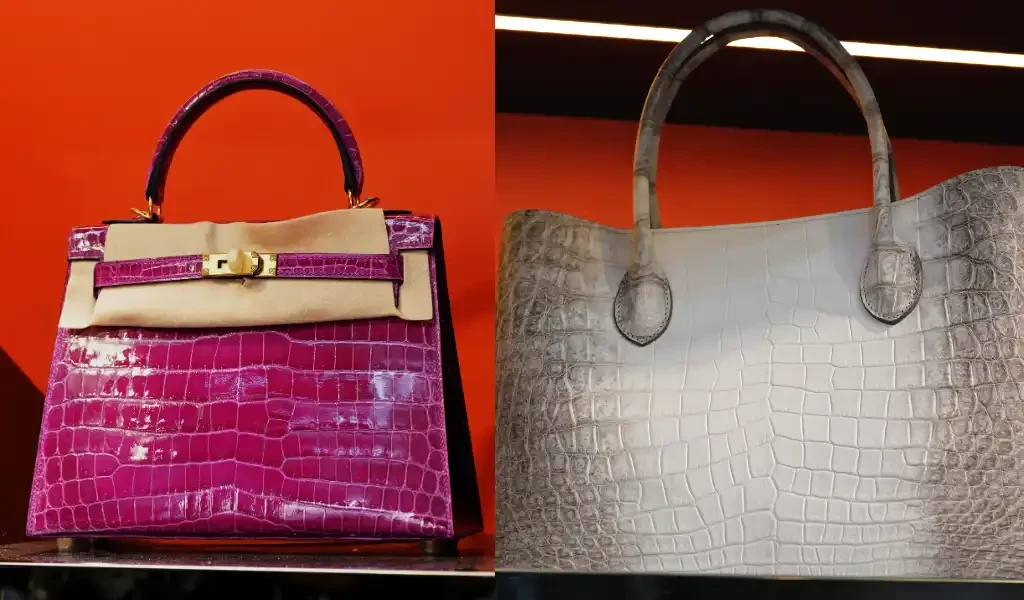
1. No Pores: A Cleaner, Smoother Surface
One of the most distinctive characteristics of alligator leather is something you notice immediately when you place it next to crocodile skin. Crocodile scales carry a small sensory pit, a pore visible at the centre of each scale. In crocodile leather, these pores are part of the material’s recognised character.
Alligator scales have no such pores. The surface of each scale is clean and uninterrupted, producing a smoother overall finish that many buyers find more refined.
For goods where a sleek, polished aesthetic is the priority, watches, straps, small leather goods, and shoes, the pore-free surface of alligator leather is a genuine advantage, and for many buyers it is the deciding factor.
The absence of pores is not a deficiency in the material, it is a defining characteristic. Alligator leather has a surface clarity that crocodile cannot match, and buyers who know the difference often seek it out specifically for this quality.
2. Symmetry: A Scale Pattern That Rivals
Among exotic leathers, scale symmetry is one of the most prized qualities in a finished piece. A belly panel where the scales mirror each other perfectly across the centre line is a mark of both the animal and the craftsperson who selected and cut it.
Porosus crocodile is known in the industry for its most symmetrical scale pattern, which is a significant part of why Porosus commands the prices it does. But alligator leather is not far behind. The alligator belly produces a highly regular, geometric scale arrangement that reads as exceptionally ordered and elegant in a finished piece.
For buyers who prioritise that visual harmony, the sense of precision and intention in the pattern, alligator leather delivers at a standard that stands comfortably alongside the finest exotic skins in the world.
Scale symmetry is one of the hardest qualities to fake and one of the easiest to appreciate. Alligator leather offers a level of pattern regularity that earns genuine respect from experienced buyers and craftspeople alike.
3. Value: Genuine Luxury at a Accessible Price
The price advantage of alligator leather over Nile or Porosus crocodile comes down to farming. Unlike crocodiles, which must be raised one per cage to avoid hide-damaging fights, alligators are less aggressive and can be farmed in groups, increasing yield and reducing production cost without any compromise to the material itself.
The result is genuine exotic leather craftsmanship at a price point that does not require the waiting lists that top crocodile goods so often demand.
Alligator or Crocodile — Which Should You Choose?
If you want the smoothest possible surface, alligator leather is the clear choice. The pore-free scale is cleaner and more refined than any crocodile equivalent, a quality that becomes especially apparent in smaller, detail-driven pieces.
If symmetry and elegance are your priority, alligator holds its own against all but the very finest Porosus crocodile, at a meaningfully lower price point.
If you are entering the exotic leather market, alligator leather is arguably the ideal starting point, genuine luxury material, exceptional craftsmanship, and a price that reflects informed production rather than artificial scarcity.
At J&A International, we carry a carefully sourced selection of alligator leather goods alongside our Nile and Porosus crocodile pieces, each CITES-certified and crafted to the standard the material deserves. If you are exploring the exotic leather market for the first time, or looking to add an alligator piece to an established collection, our Hong Kong team is happy to guide you. Reach out to learn more.