The rumour persists that luxury houses artificially restrict how many crocodile leather bags they release each year to drive up prices. From deep inside the supply chain, we can say with confidence: that is not what is happening.
5 min read | Crocodile Leather | Supply Chain | Luxury Sourcing
Farming
Individual Cage Raising
- One crocodile per cage, no mass rearing
- Long growth cycle to full hide maturity
- Hard ceiling on annual output volumes
- Scale cannot be increased without quality loss
Grading
Most Hides Never Qualify
- Strict grade 1 criteria, scars disqualify
- Only a fraction of the annual output passes
- Top-tier grades secured by major brands first
- Remainder rarely reaches the open market
Craftsmanship
A Finite Number of Masters
- Tanning is a highly specialised discipline
- Master craftspeople take years to develop
- Finished pieces per atelier are strictly limited
- Each piece represents rare converging expertise
The Misconception Worth Correcting
The theory goes like this: Hermès, Gucci, and the other great houses could produce far more crocodile leather bags than they release; they simply choose not to, in order to protect price and prestige.
It is the kind of story that feels plausible from the outside. From inside the supply chain, working directly with the farms and tanneries, the picture is entirely different.
The scarcity of top-grade crocodile leather is not a strategy. It is a hard constraint that begins long before any luxury brand enters the picture.
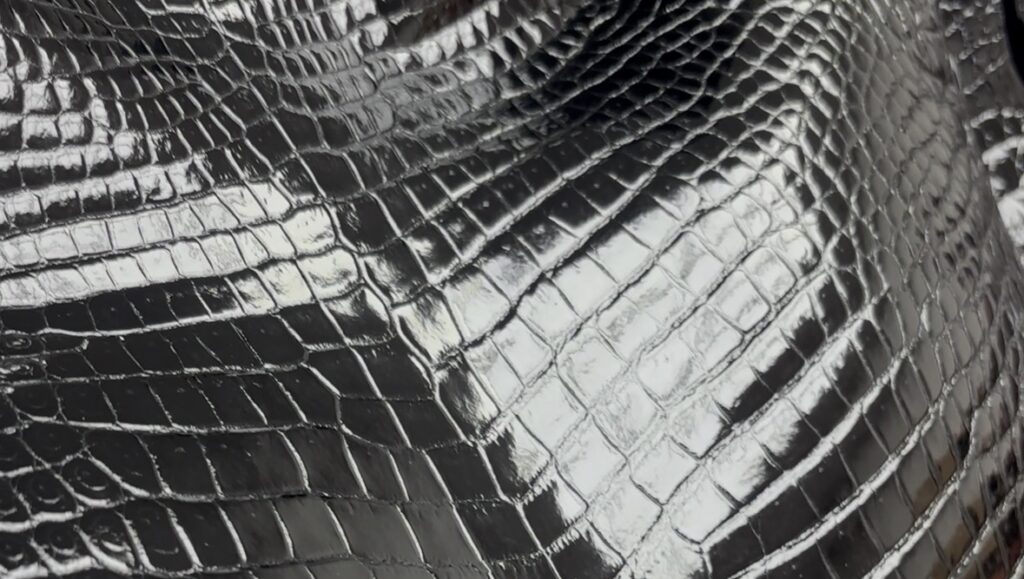
1. Individual Cage Farming Places a Hard Ceiling on Supply
Porosus and Nile crocodiles are not farmed the way most livestock is raised. Each animal is housed in its own individual cage throughout the growth cycle, a practice that is essential for producing undamaged hides.
Crocodiles raised in group enclosures fight. The resulting bites, scratches, and abrasions leave scars that permanently disqualify a hide from top-grade crocodile leather classification. Individual cage raising is the only reliable method for producing scar-free skins.
That method creates an absolute ceiling on production volume. You cannot raise more crocodiles in the same space without compromising the quality that defines premium crocodile leather. The supply is structurally limited before a single grading decision is made.
Individual cage farming is not a luxury, it is a necessity. It is also the single biggest reason that top-grade crocodile leather production cannot simply be scaled up to meet growing demand from luxury brands.
2. A Strict Grading System Eliminates Most of What Is Produced
Even after careful individual cage farming, only a fraction of hides produced each year will meet the grading threshold required for the finest crocodile leather goods.
The grading criteria are uncompromising. A single scar, healed bite mark, or surface irregularity is enough to move a hide from the top grade to a lower classification. The highest grades — those used in Birkin bags and equivalent pieces — represent only a small proportion of annual output, even from the best farms.
What passes the grade is then subject to another competitive reality: the major luxury houses have established procurement relationships that give them first access. The finest crocodile leather available in a given year is effectively pre-allocated to these brands. Very little, if any, reaches the broader market.
At J&A, working directly with suppliers, we see this play out each season. The highest grades of Porosus and Nile crocodile leather are not available to source freely, they are secured by the major houses before the open market has the chance to access them.
3. Master-Level Tanning and Craft Cannot Be Replicated at Scale
Even if supply were abundant, which it is not, the finished production of elite crocodile leather goods would still be limited by the craftsmanship required to produce them.
The tanning process for top-grade Porosus and Nile crocodile hides is among the most technically demanding in the leather industry. It requires years of specialised training to master, and the number of artisans working at that level globally is small.
Each finished piece, whether a bag, a wallet, or a belt, represents the convergence of exceptional raw material, exceptional tanning, and exceptional construction. All three are rare. Together, they are genuinely finite. The brands producing at this level are not holding back output; they are working at the limits of what is achievable.
Are the Brands Doing This Deliberately?
No, and the supply chain confirms it. The scarcity of top-grade crocodile leather goods is due to their not being manufactured. It is the natural result of individual cage farming, strict grading, and the finite capacity of master-level craft.
The brands are doing everything possible to meet demand. From what we see at the supplier level, the major luxury houses are not withholding product, they are absorbing every top-grade hide available and still cannot keep pace with the market.
Crocodile leather at the highest grade is rare because producing it, at every stage of the chain, is extraordinarily difficult. The price reflects that reality, not an artificial restriction.
Summary
There is a widespread belief that brands like Hermès intentionally cap production of their crocodile leather goods to manufacture scarcity and justify high prices. It is an appealing theory. It is also wrong.
The reality, as seen from the supplier level, is that the highest grades of Nile and Porosus crocodile leather are genuinely rare, absorbed almost entirely by major luxury houses before they ever reach the open market. The scarcity begins at the farm, intensifies through grading, and is compounded by the limits of master-level craftsmanship. No brand can manufacture what the supply chain simply cannot produce.
At J&A International, we work directly with Porosus and Nile crocodile leather suppliers and understand the supply chain at every level. Each exotic leather piece we offer is sourced from verified, CITES-certified farms and crafted to the standard the material demands. Contact our Hong Kong team to learn more about our exotic leather collection.