If you’ve noticed that lynx cat coats come in two very different colour profiles, you’re asking the right question. The answer reveals everything about how the pelt is sourced, graded, and used.
Key takeaways
- Both types come from the same animal: the white belly and orange body lynx cat coats are simply different cuts from the North American lynx or bobcat hide.
- The protected grey-white lynx is not involved: every legitimate lynx cat coat uses the yellow-and-white variety, which is not under species protection.
- The belly yields only a few square centimetres of white per pelt: that scarcity is the entire reason all-white belly lynx cat coats start at $80,000.
- The orange body is the “leftover”, but not waste: European artisans combine it with white fox fur and other materials to create distinctive, high-quality garments in their own right.
- Always verify CITES documentation: it is the only proof that a lynx cat coat was legally and ethically sourced.
White Belly Type
Ultra Premium
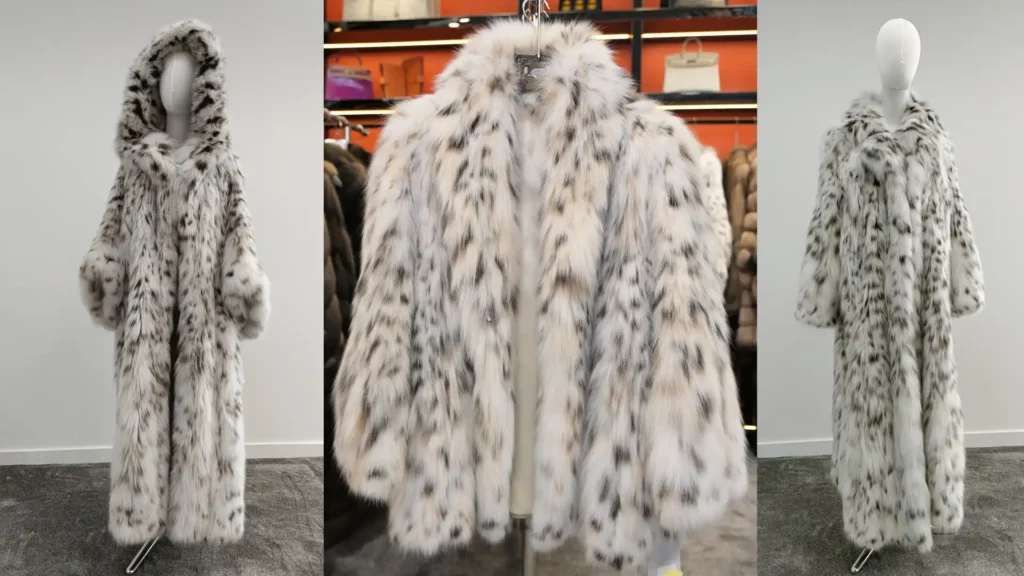
Pure white with black spots. Cut from the belly only. Tiny surface area per pelt requires dozens to hundreds of pelts for one coat. Starts at $80,000+.
Orange Body Type
Classic Type
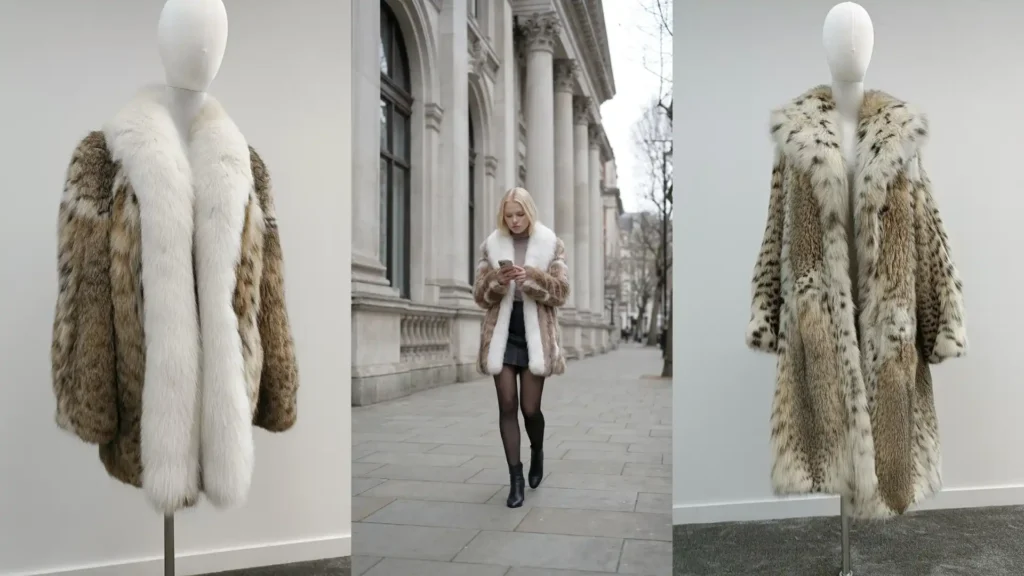
Orange-yellow base with white and black markings. Cut from the body of the pelt. More surface area available, the creative alternative to the belly cut.
First, the Animal Worth Knowing About
Every lynx cat coat in the market today comes from the North American lynx or bobcat, specifically the yellow-and-white variety.
The all-grey or all-white lynx, by contrast, is a protected species and cannot be legally sourced anywhere. It is not the animal behind any legitimate lynx cat coat on the market.
What manufacturers work with is a pelt that is predominantly orange-yellow on the body, with a distinctly different white section on the belly, and these two zones are treated entirely separately.
Why the Belly Is the Most Precious Part
When a manufacturer receives a processed lynx cat pelt, the first thing they do is identify and cut away the white belly section.
This section is the most sought-after part of the entire hide. However, each pelt yields only a few square centimetres of usable all-white belly, making it extraordinarily scarce.
As a result, assembling a full lynx cat coat from belly pieces alone requires tens, sometimes hundreds, of individual pelts. That accumulation of rare material is precisely why all-white belly lynx cat coats start at $80,000 and climb from there.
In practical terms, the white belly section of a single lynx cat pelt might cover an area no larger than your palm. Everything else on the hide is the orange-yellow body.
What Happens to the Rest of the Pelt
Once the belly is removed, artisans are left with the larger orange-yellow body section, which, despite being the majority of the hide, was traditionally considered the secondary cut.
It may seem counterintuitive that the more abundant part of the pelt is less valuable. Nevertheless, that is exactly the dynamic at play: scarcity, not size, drives price in the lynx cat coat market.
That said, the orange body is far from waste. European artisans have developed increasingly creative ways to work with it, most notably by combining it with white fox fur to produce lynx cat coats that blend the distinctive spotted pattern of the body with the clean white softness of fox. The result is a garment that is bold, unique, and a genuinely skilled piece of fur craftsmanship in its own right.
Before you buy any lynx cat coat, Always verify ethical sourcing documentation. Legitimate lynx cat coats come with CITES certification and proof of legal, quota-regulated sourcing from North America. No documentation means no guarantee; walk away.
Summary
The two versions of the lynx cat coat, the all-white belly type and the orange-yellow body type, come from exactly the same animal. The difference lies entirely in which part of the pelt is used.
The white belly section is extraordinarily rare, commanding the highest price in the fur market. The orange body section, by contrast, was long considered a secondary cut, until European artisans found creative ways to transform it into something equally desirable in its own right.
Interested in a lynx cat coat, belly or body type? The J&A team in Hong Kong carries both, with full ethical sourcing credentials on every piece. Reach out to learn more.