The usual logic says that high prices attract more supply, and more supply brings prices down. For Porosus crocodile leather, that logic simply does not apply and here is exactly why.
Key takeaways
- Porosus cannot be group-farmed: individual housing requirements multiply costs in a way no other commercial leather species demands.
- CITES compliance adds continuous operational cost: it is not a one-time hurdle but an ongoing expense that discourages new supply from entering the market.
- Most farmers choose easier species: the risk-reward profile of Porosus pushes producers toward Siamese or alligator, keeping Porosus supply structurally constrained.
- Larger size means longer exposure to risk: the extended rearing period required for premium Porosus hides increases the chance of total loss, compounding the cost per viable skin.
- Breeding is slow and difficult: supply cannot be scaled quickly even when the will and capital exist, making Porosus crocodile leather a structurally scarce material for the foreseeable future.
1. Porosus Cannot Be Farmed as a Group
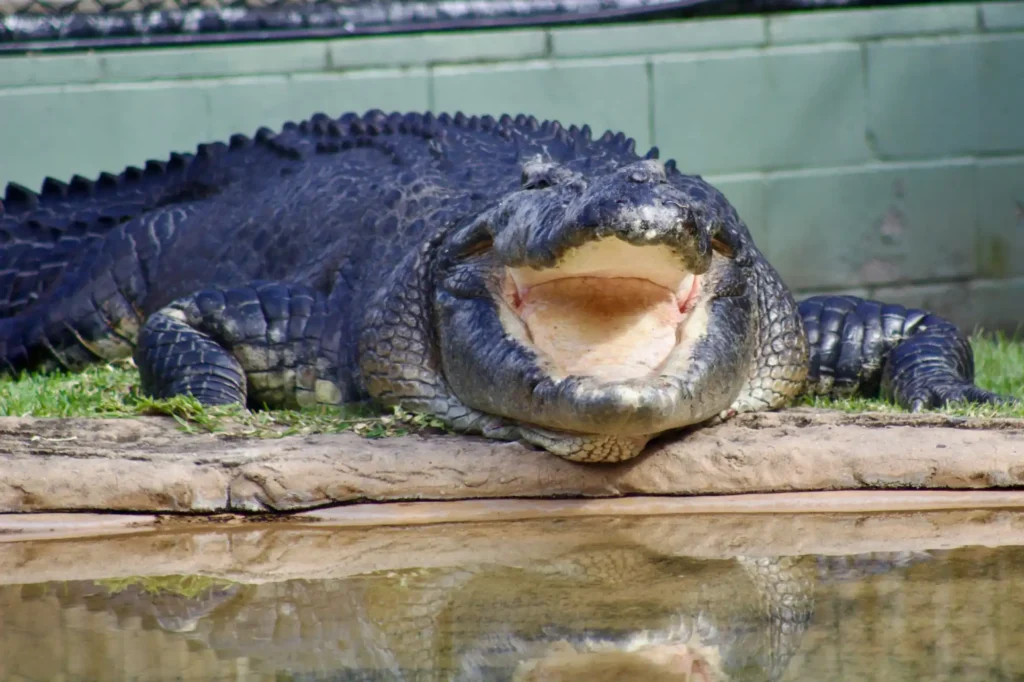
The Porosus crocodile is one of the most territorial animals on the planet.
Unlike the Siamese crocodile or alligator, which can coexist in shared enclosures, every Porosus crocodile must be raised in its own individual space. That single fact multiplies land, labour, and infrastructure costs dramatically compared to any other farmed leather species.
Furthermore, even with individual housing, a flawless hide is never guaranteed. Growth rate, diet, environment, and stress all affect the quality of the final skin, making the entire investment inherently unpredictable.
2. CITES Compliance Is an Ongoing Cost
Porosus crocodile is listed under CITES Appendix I and II, among the most stringently regulated species in international trade.
As a result, every farm must meet rigorous ongoing requirements covering animal welfare, population reporting, and hide traceability. Compliance is not a one-time certification, it is a continuous operational burden that adds cost at every stage of production.
Consequently, new entrants face not just high capital costs but a sustained regulatory overhead that discourages many potential farmers before they begin.
3. Farmers Choose Easier Species Instead
The economics of farming Porosus crocodile leather are simply less attractive than the alternatives.
Species like Siamese crocodile can be raised communally, grow to a commercially viable size more reliably, and produce a saleable hide at a lower cost per animal. For most farmers, the lower margin per hide is more than offset by the higher volume and lower risk.
In other words, Porosus crocodile leather’s premium pricing attracts attention, but the operational reality pushes most farmers toward safer, less demanding species. Supply stays constrained not because the price isn’t tempting, but because the work is genuinely harder.
Hermès famously operates its own dedicated Porosus crocodile farm in Australia, a clear indication of just how difficult it is to secure consistent, top-grade supply through open market channels.
4. Luxury Brands Require a Larger Animal, Which Takes Longer and Risks More
The scale pattern that defines premium Porosus crocodile leather only reaches its ideal symmetry and refinement at a larger body size, typically well beyond what is needed for Siamese or alligator hides.
That extended growth period increases exposure to disease, injury, and environmental stress. A single illness can render a year or more of investment worthless overnight.
As a result, the cost per viable Porosus crocodile hide is not just higher at the outset, it compounds over the entire rearing period, with the risk of complete loss never fully disappearing.
5. Breeding Porosus Is Notoriously Difficult
Even maintaining an existing Porosus crocodile population is a challenge, let alone growing one.
Successful breeding requires precise temperature control, careful monitoring of both physical and psychological health, and near-ideal conditions at every stage. The animals’ territorial nature complicates every aspect of the process.
Consequently, even well-resourced farms struggle to increase their breeding stock at any meaningful pace. Supply growth, therefore, is slow almost by definition, and demand for Porosus crocodile leather at the luxury tier shows no sign of slowing with it.
Summary
In most markets, sustained high prices eventually attract enough new supply to push costs down. Porosus crocodile leather is one of the rare exceptions, and the reasons are structural, not cyclical.
From the animal’s intensely territorial nature to the strict requirements of CITES certification, every stage of Porosus crocodile leather production resists scaling. As a result, this is a material whose price is more likely to rise over time than fall.
Looking for authentic Porosus crocodile leather pieces with full CITES documentation? The J&A team in Hong Kong works directly with licensed sources. Reach out to explore what’s available.