
Rising fur pelt prices are only half the story. The real pressure on luxury fur garment costs runs deeper, through disrupted shipping routes, surging oil prices, and a global supply chain that was never built for the volatility we’re seeing today.
5 min read | Fur Industry | Supply Chain | Market Insight
Key takeaways
- Rising fur pelt prices are only half the story: logistics disruptions and surging oil costs are compounding the pressure across the entire fur supply chain.
- The fur supply chain spans three continents: raw materials from Europe and North America, processing in Southeast Asia, and finished garments delivered globally.
- Global conflict has disrupted key shipping routes: longer rerouted voyages add time and cost to every shipment of fur pelts and dressed skins.
- Oil price volatility hits the supply chain at every leg: both cold-storage sea freight and air cargo costs have surged, passing costs down to the end consumer.
- Sudden price increases carry real risk: for buyers, retailers, and producers alike; transparency about the causes is essential to confident decision-making.
- Certifications are a guarantee of quality and ethics: every J&A piece is certified by CITES, FURMARK, and SAGA Furs, ensuring full traceability regardless of market conditions.
Raw Material Stage
Europe & North America
- Primary fur pelt sourcing regions
- Regulated farming & ethical standards
- Pelt prices rising at auction
- CITES & FURMARK certified supply
- Shipped by air or cold-storage sea freight
Processing Stage
Southeast Asia Hub
- Global centre for fur dressing
- Strategic location between Europe & East Asia
- Generations of specialist expertise
- Logistics costs surging with oil prices
- Dressed skins shipped to garment manufacturers
Why Fur Pelt Prices Are Rising But That's Only Half the Story
Much of the recent commentary on the luxury fur market has focused on fur pelt prices. Auction results across Scandinavia and North America have climbed significantly, and that increase feeds directly into the cost of every finished fur garment. The math is straightforward: when the raw material costs more, the product costs more.
But attributing the full price increase to raw material costs alone misses the larger picture. The fur supply chain is an international system, and it is being pressured at every stage simultaneously, not just at the source.
Understanding the Fur Supply Chain
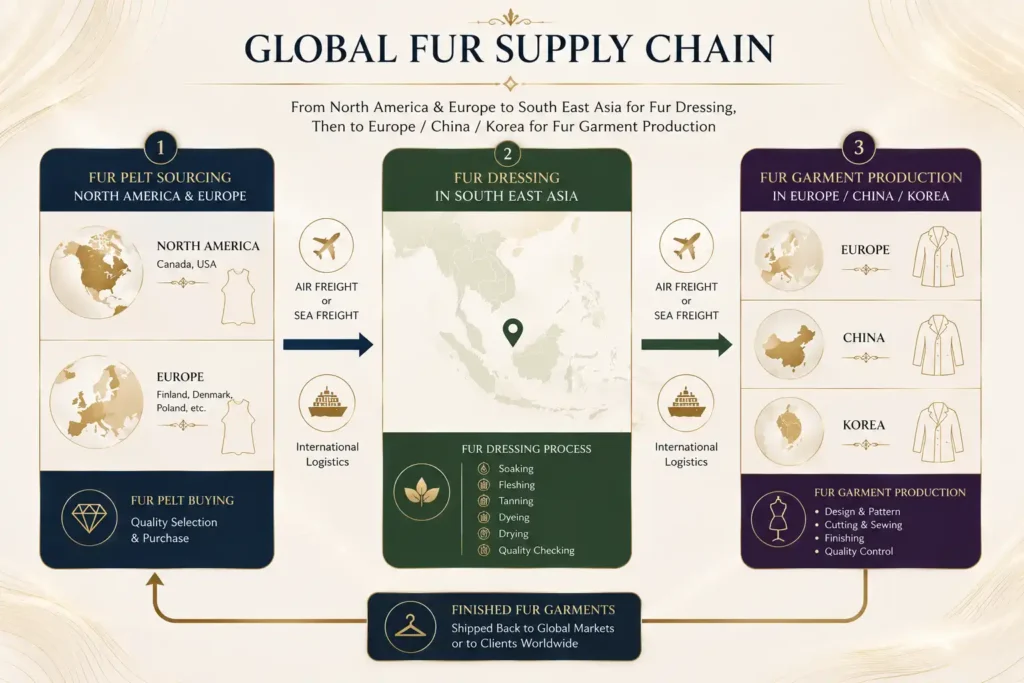
Raw pelts are primarily sourced from Europe and North America, where regulated farming and trapping practices meet strict animal welfare and environmental standards. From there, they travel to Southeast Asia, a region that has established itself as the undisputed global hub for fur dressing and processing. Thanks to its strategic geographic position between Europe and East Asia, as well as generations of accumulated expertise, Southeast Asia transforms raw hides into dressed skins ready for luxury production.
Once processed, the dressed fur moves onward, either back to Europe’s renowned ateliers or east to the fashion houses and manufacturers of China, Korea, and beyond. The finished fur garments then reach consumers worldwide through luxury retail channels.
This fur supply chain depends on precision logistics. Depending on the type of pelt and urgency, materials travel by air freight or by sea in temperature-controlled cold-storage containers. Every link in the chain must function cleanly for the system to work.
The choice between air freight and cold-storage sea shipping is not just a cost decision, it is a quality decision. Certain delicate pelts cannot withstand extended transit times, making air freight non-negotiable regardless of the cost. When fuel prices surge, those decisions become significantly more expensive.
How Global Conflict Is Breaking the Chain
Ongoing geopolitical conflicts have introduced two compounding pressures into the fur supply chain, and both are being felt at once.
First, key shipping routes have been disrupted. Conflict in strategically critical regions has forced vessels onto longer alternative routes, adding transit time and operational cost to every shipment moving through the supply chain. For a system that depends on timely cold-chain delivery, extended transit times are not merely inconvenient, they are costly.
Second, oil price volatility has pushed fuel surcharges to new highs across both sea freight and air cargo. For the fur supply chain, which moves material across three continents in temperature-sensitive conditions, these increases compound at every leg of the journey.
The result is predictable: elevated logistics costs are passed along at every stage, arriving at the end consumer in the form of higher prices on finished luxury fur garments.
The Risk of Sudden, Elevated Prices
A gradual increase in fur garment prices can be absorbed and explained. A sudden, sharp increase, driven by a confluence of factors that hit simultaneously, is a different matter entirely.
When prices rise faster than the market expects, it creates genuine uncertainty: for consumers trying to make considered purchasing decisions, for retailers managing inventory, and for producers who cannot easily predict their own cost base from one season to the next.
We do not believe in forecasting what we cannot know. The trajectory of global conflict, oil prices, and the fur supply chain disruptions that flow from them is not something any company can predict with confidence. But we do believe that informed buyers are better positioned than uninformed ones, and that is precisely why we are sharing this analysis.
Where Does the Fur Supply Chain Go From Here?
The pressures are real, and they are not resolved. Shipping route disruptions and oil price volatility remain live factors across the global logistics landscape, and the fur supply chain remains exposed to both.
What does not change is quality and traceability. The certifications that govern ethical fur sourcing; CITES, FURMARK, SAGA Furs, remain in place and remain the most reliable indicator that a fur garment was produced with full accountability at every stage.
We will continue to monitor conditions and keep our clients informed. What we can guarantee is that every piece leaving our atelier carries the documentation to prove exactly where it came from.
Summary
The fur supply chain is a precisely balanced international network, raw pelts from Europe and North America, processed in Southeast Asia, then delivered to luxury ateliers worldwide. For decades, this system ran with quiet efficiency.
Today, ongoing geopolitical conflicts are disrupting key shipping routes and driving fuel costs to new highs. The result is a wave of elevated fur garment prices that has left many consumers without a clear explanation. At J&A International, we believe you deserve one.