
Buying a high-quality crocodile bag is one of the finest investments you can make in luxury fashion. The difference between extraordinary and ordinary is entirely in the details. Here’s exactly what to look for.
4 min read | Crocodile Leather | Buyer's Guide | Exotic Leather
Key takeaways
- Inspect color and scale symmetry under natural light: inconsistency in either is an early and reliable signal of inferior materials.
- Panel matching reveals the maker’s standards: seamless joins require both exceptional sourcing and the willingness to reject hides that fall short.
- Softness proves the tanning: a genuinely supple hide leaves no room to conceal tanning imperfections.
- Always open the bag: the interior is where corners are cut, and where true quality is confirmed.
- Ask for CITES documentation: no paperwork means no traceable standard, and no traceable standard means no confidence in the leather itself.
1. Color Consistency
On a high-quality crocodile bag, the color must be perfectly uniform across every scale, every panel, and every corner. Tilt the bag under natural light and inspect all angles before you commit. Any patchiness, fading, or variation in depth is a sign of uneven dyeing or inferior tanning, and it will only become more visible as the piece ages.
2. Scale Symmetry
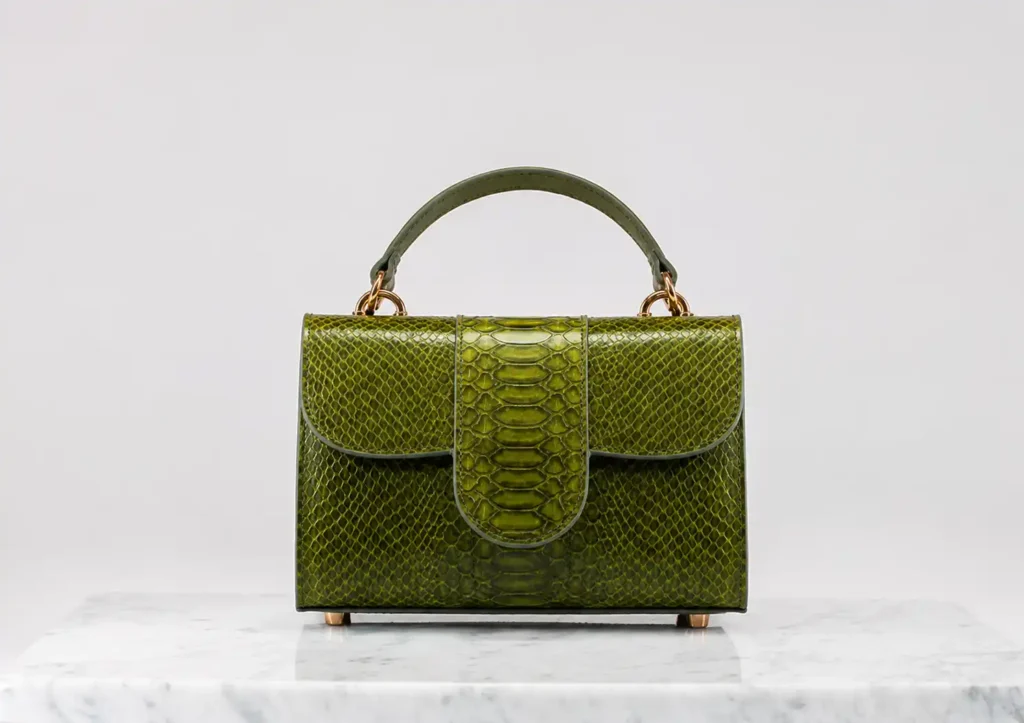
The scale pattern is the visual signature of genuine crocodile leather, and one of the primary justifications for its price. On a high-quality piece, scales are geometrically even, well-proportioned, and consistent in their natural structure. Irregular, misshapen, or poorly defined scales indicate lower-grade leather or, in some cases, an embossed imitation designed to deceive.
3. Panel Matching
No single hide is large enough to construct a full bag. Every crocodile leather bag is assembled from multiple skins, and how seamlessly those panels are matched is a direct measure of the maker’s skill and the quality of their sourcing. Scale size, texture, pattern flow, and color depth must align naturally across every seam. In the finest pieces, the joins are all but invisible.
Visible mismatches between panels signal that either inferior hides were used, or the maker lacked the inventory and the standards to select them properly.
4. Softness of the Skin
Softness is shaped by two factors: species and tanning. Porosus and Nile crocodile hides are widely regarded as the finest available, prized for their naturally fine-grained scales and inherent suppleness. But the tanning process is what ultimately determines the result. A skilled tannery achieves remarkable pliability without weakening the hide. When you handle the bag, it should move naturally in the hand, supple and responsive, never stiff.
5. Curves and Folds
Crocodile skin is inherently firmer than cowhide, making the shaping of curves and folded edges one of the most demanding aspects of the craft. In lesser pieces, these stress points crack, pucker, or deform over time. On a high-quality crocodile bag, every curve holds its intended form, not only when the bag is at rest, but equally when it is carried on the shoulder or in the hand.
6. Stitching Quality
Precise, even stitching does more than look elegant; it structurally supports the leather and preserves the bag’s silhouette for years. Every stitch should be identical in size and spacing, with no loose threads, puckering, or uneven tension. Stitching quality is a reliable indicator of how the bag will age and what the maker believed it was worth building to last.
7. Interior Construction
Open the bag. The interior should be as thoughtfully finished as the exterior, with clean edges, quality lining, well-placed pockets, and no raw seams or excess adhesive. The interior is the easiest place for a maker to cut costs invisibly, which is precisely why a discerning buyer should always look inside.
A flawless exterior paired with a rushed interior is a warning, not a compromise. True craftsmanship does not stop where the eye stops looking.
8. Hardware Quality
Hardware is the jewellery of a crocodile leather bag, the finishing element that either elevates or undermines everything around it. Clasps, zips, D-rings, and feet should feel solid in weight, precise in finish, and consistent in color with no tarnishing. Poor hardware fails before the leather does and becomes a costly, difficult repair on a piece that deserved better.
9. CITES Certification
CITES certification is the international standard for the ethical and traceable sourcing of genuine crocodile leather from regulated, world-class farms. It is not merely a legal formality; certified farms operate at a standard of animal husbandry and hide quality that uncertified sources cannot reliably match. Always ask for documentation. A credible seller will have it readily available.
The absence of CITES paperwork is, at best, a question mark and at worst, a meaningful signal about the quality of the leather and the integrity of the maker.
Summary
Nine qualities define a truly high-quality crocodile bag: color uniformity, scale symmetry, panel matching, softness, clean curves, precise stitching, interior construction, hardware, and CITES certification. Each one is a signal, and together, they tell the complete story of the piece in your hands.
A high quality crocodile bag, evaluated with these nine standards in hand, is a piece that will reward its owner for a lifetime. The differentiation is always in the detail.