
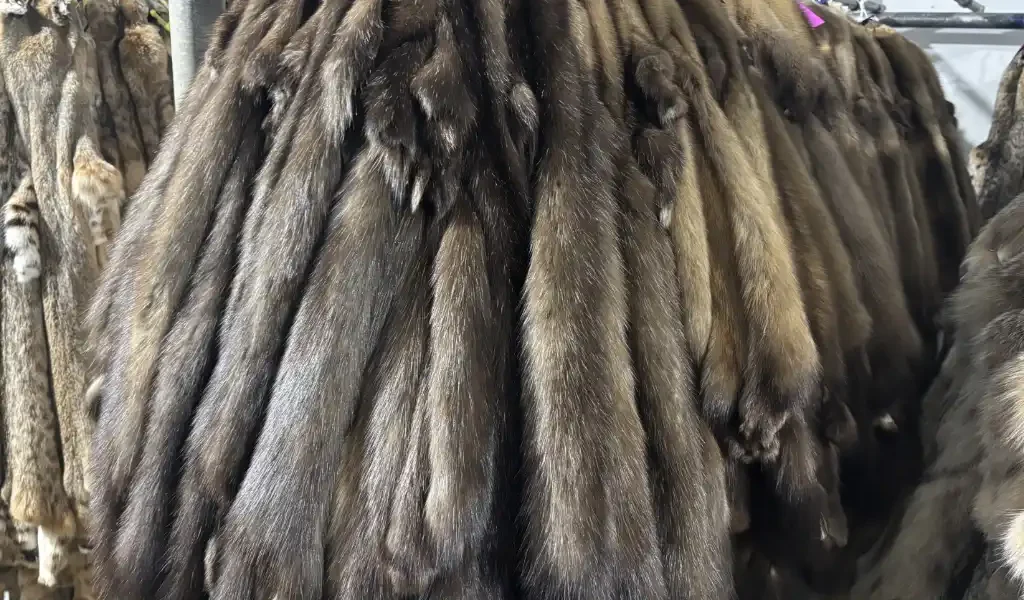
At first glance, marten and Russian sable look almost identical — long, soft, and effortlessly elegant. Look more closely, and one difference emerges that no amount of dressing technology has been able to solve: the yellow.
4 min read | Russian Sable | Marten | Buying Guide
Summary
Marten is frequently sold as a lower-cost alternative to Russian sable, and in terms of overall appearance, the comparison is reasonable. Both animals produce long, soft fur with a similar silhouette. For buyers who do not know what to look for, marten can pass.
But there is one quality difference between the two that no modern dressing technique has been able to resolve: marten fur carries a deep, inherent yellow pigment. It survives bleaching. It survives dyeing. It resurfaces. And it places a hard limit on the colour range that marten garments can ever convincingly achieve, a limit that Russian sable does not share. That limitation explains why marten is almost exclusively sold in dark or natural colours, and why it will never fully substitute for sable at the top of the market.
Russian Sable
The Colour Standard
- Neutral base: takes any colour cleanly
- Excels in light colours: lavender, grey, white
- No underlying pigment competing with the dye
- Full colour range achievable at dressing stage
- Silvery character preserved through any colour
Marten
The Yellowing Problem
- Deep yellow pigment inherent to the fur
- Survives bleaching: cannot be fully removed
- Light colours show yellowing along the pelt
- Sold almost exclusively in dark or natural tones
- No current dressing solution has resolved this
Two Animals That Look Almost the Same
Marten and Russian sable belong to the same family, share a similar build, and produce fur with a broadly similar character: long, flowing, and exceptionally soft. For buyers browsing without prior knowledge of either species, the two can appear interchangeable at first inspection.
That similarity is exactly what makes marten such a common substitute in the market. As covered in our piece on sable fur authenticity, the differences between the two are real and meaningful, but they are not immediately obvious to an untrained eye, and some sellers rely on that ambiguity.
Understanding the single most important difference between them is the most useful thing any prospective buyer can know.
The Yellowing: A Problem No Dressing Technology Has Solved
Marten fur carries a deep yellow pigment that is intrinsic to the structure of the hair itself. This is not a surface property that can be washed away, and it is not an artifact of poor farming or dressing practice. It is a biological characteristic of the animal, present in the fur regardless of where or how the marten was raised.
The practical consequence is that this yellow pigment cannot be fully removed through dressing. Bleaching reduces it but does not eliminate it. Dyeing over it works in dark colours, where the depth of the dye is sufficient to suppress the yellow underneath, but in lighter colours, the underlying pigment pushes through. The finished pelt shows a yellowing along its length that the dye cannot hide.
This is not a problem that modern dressing technology has solved. Despite significant advances in fur dressing across the board, as discussed in our piece on colour correction, the inherent yellow of marten fur remains one of the few colour challenges that the industry has not been able to engineer away.
The yellowing in marten is not a quality control failure; it is a biological property. The distinction matters because no amount of improved dressing technique will resolve it. It is structural, not procedural, and that is precisely why it defines the ceiling of what marten can achieve as a material.
Where the Difference Becomes Most Visible
The clearest way to see the contrast between Russian sable and marten is in light colours. Lavender, light grey, ivory, soft white. These are the palettes where sable’s neutral base delivers results that no other fur in its category can match. The dressing process can bring sable to a pure, clean expression of any of these tones because there is no competing underlying pigment working against it.
Attempt the same colours in marten, and the result is immediately and unmistakably different. The yellow pigment does not disappear under light dye; it shifts it. A lavender marten garment reads with a warm, yellowish cast. A light grey develops a slightly mustardy undertone. The colour the dresser intended and the colour the buyer receives are not the same thing.
This is why marten garments are sold almost exclusively in dark or natural tones, deep browns, blacks, and rich naturals where the yellow pigment is effectively absorbed into the depth of the colour and becomes invisible. In those colours, marten is genuinely beautiful. But those colours are also the extent of what marten can reliably be.
The colour range of Russian sable is limited only by the skill of the dresser. The colour range of marten is limited by its biology. That is the most honest summary of why the two animals are not interchangeable, and why sable commands the price it does.
What This Means When You Are Buying
For any buyer considering a lighter-coloured fur garment, whether lavender, grey, white, or any other pale tone, the yellowing issue is a direct and practical reason to insist on certified Russian sable rather than accept a marten substitute.
In darker colours, the choice is more nuanced. A well-dressed marten garment in a deep brown or black is a genuinely beautiful piece, the yellowing is invisible, the softness is comparable, and the price is meaningfully lower than sable. For buyers working within a budget and committed to a dark colour, marten deserves serious consideration on its own terms.
What matters most is knowing which animal you are buying, at what price, and with what certification. A marten garment sold transparently as marten at a marten price is a legitimate purchase. A marten garment sold as sable at a sable price is not — and the colour of the garment is often the easiest way to identify which situation you are in.
Marten or Russian Sable: How to Choose?
If you want a light-coloured garment, there is only one answer: Russian sable. No marten garment in lavender, grey, or any pale tone will deliver the clean, pure result that sable’s neutral base makes possible. The yellowing will be there.
If you want a dark-coloured garment and a lower price, marten deserves honest consideration. In deep natural or dark tones, the yellowing is invisible — and the softness and silhouette are genuinely comparable to sable.
Whatever you choose, insist on certification. The only reliable protection against paying sable prices for marten is documentation that traces the pelt to its verified origin. At J&A, that documentation is part of every piece we sell.
At J&A International, every Russian sable garment in our collection is certified by SOBOL and FURMARK, guaranteeing verified Russian origin and the quality standard that genuine sable demands. If you are choosing between sable and marten, or simply want to understand what you are looking at, our Hong Kong team is here to help. Visit j-a-international.com to explore the collection.