
Modern tanning has solved almost every criticism once levelled at crocodile leather. Stiffness, softness, colour uniformity, all addressed. But one challenge remains, rooted in the biology of the animal itself: weight.
4 min read | Crocodile Leather | Buying Guide | Craft & Care
Summary
Crocodile leather is widely regarded as the most prestigious leather on the planet, the scale pattern is unmistakable, the rarity is real, and modern tanning has resolved the thickness and stiffness issues that once made it demanding to wear. Saltwater crocodile skin, in particular, sits at the very pinnacle of what exotic leather can be.
But there is one challenge that tanning technology has not yet solved, and may never fully solve: density. Crocodile skin is extraordinarily dense by nature, a product of the environment the animal evolved in, and that density means weight. It is the material’s one remaining stigma, and the right way to approach it is not to ignore it, but to understand it and choose pieces accordingly.
Solved
What Modern Tanning Fixed
- Thickness: skin can now be thinned significantly
- Stiffness: bone removal produces a supple hand
- Softness: approaches cowhide with right tanning
- Colour uniformity: dye absorption now even
Unsolved
What Remains a Challenge
- Density: inherent to the animal’s biology
- Weight: density cannot be tanned away
- Larger pieces carry noticeably more heft
- No tanning breakthrough has changed this yet
The Approach
Start Small, Go Gradually
- Begin with a small accessory piece
- Build familiarity with the material’s feel
- Progress to larger pieces when ready
- Let appreciation develop naturally over time
The Most Prestigious Leather in the World With One Caveat
There is no serious debate about where crocodile leather sits in the hierarchy of exotic materials. The scale pattern is unique to the species, instantly recognisable, and impossible to replicate in any other leather. Saltwater crocodile skin, Porosus, occupies the very top of that hierarchy, prized for the regularity of its scales and the rarity of material at the highest grades.
Modern tanning has addressed nearly every practical criticism the material once attracted. Thickness, stiffness, softness, colour, all have been transformed by advances in dressing technique, as covered in our earlier pieces on crocodile leather innovation and bag stiffness.
One challenge remains. And unlike stiffness or colour, it cannot be engineered away.
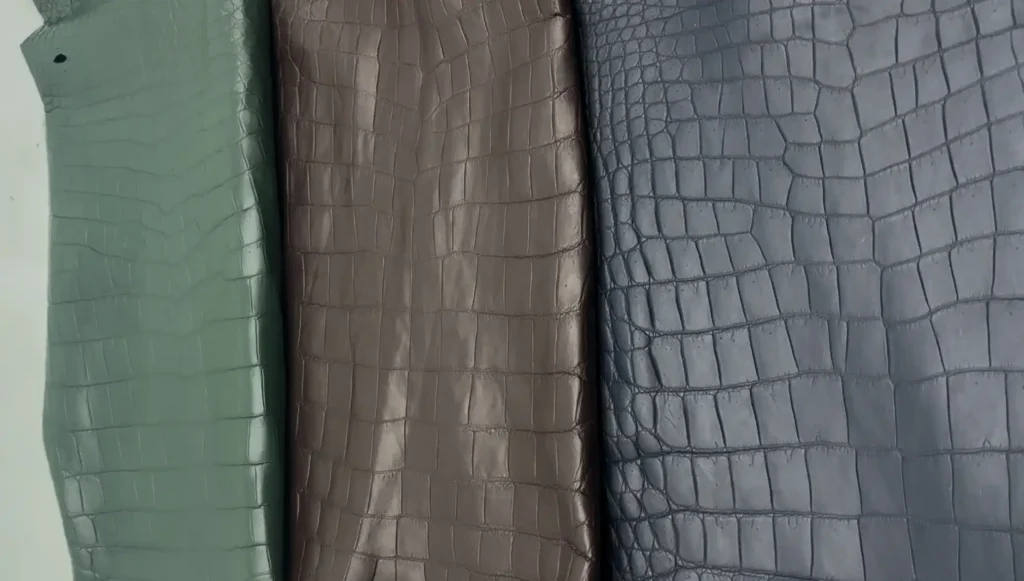
Why Crocodile Leather Will Always Carry Some Weight
Crocodiles evolved in some of the most physically demanding environments on earth: freshwater rivers, tidal estuaries, and saltwater coastlines. To survive in those environments, they developed extraordinarily dense, layered skin as a form of natural armour.
That density is precisely what gives crocodile leather its remarkable durability and its distinctive depth of texture. It is also what makes the material heavier than most other leathers, even after tanning.
Thickness can be reduced in the tanning process, and today’s tanneries do exactly that. But density is a different property. It describes the mass of the material at a given volume, and no tanning process currently available changes that in any meaningful way. A thin slice of crocodile leather is still denser than a comparably thin slice of most other leathers, and that density accumulates across a larger piece.
The weight of crocodile leather is not a quality issue or a craftsmanship issue. It is a biological property of the animal, as intrinsic to the material as the scale pattern itself. Understanding that distinction changes how you evaluate and choose pieces.
The Right Way to Approach Crocodile Leather
Knowing that weight is an inherent property of crocodile leather, the most practical advice we can offer any buyer, especially a first-time buyer, is to start small and progress gradually.
A wallet, a watch strap, a card holder, a compact piece lets you build a genuine feel for the material: its texture, its depth, its character in daily use. Many buyers who begin there find that what initially felt unfamiliar becomes something they actively seek. The weight, in a small piece, is barely perceptible, and the presence of the material more than compensates.
From there, a belt. Then a bag. Then, for those who arrive at full appreciation of the material, a larger piece. Each step builds the kind of familiarity that makes crocodile leather wearable and enjoyable in daily life rather than occasional and ceremonial.
The buyers who love crocodile leather most deeply are almost never those who started with a large piece. They are the ones who built their relationship with the material over time, piece by piece, and arrived at an appreciation that no shortcut can replicate.
Should Weight Put You Off Crocodile Leather?
No, but it should inform your choices. Weight is the one honest limitation of crocodile leather that modern tanning has not resolved. Knowing that going in means you can choose pieces where the weight is irrelevant: small goods, accessories, straps, and progress to larger pieces with realistic expectations.
The material is too extraordinary to leave in storage. A crocodile leather masterpiece exists to be worn, admired, and shared, not kept behind glass. The people who carry and wear these pieces are the ones who keep the art of exotic leather craft alive and meaningful.
Start where you are comfortable, and let the material speak for itself. We have never met a buyer who regretted taking that first step.
At J&A International, our crocodile leather collection spans every entry point, from compact card holders and watch straps to full bags and jackets, all CITES-certified and crafted to the highest standard. If you are starting your crocodile leather journey or looking to take the next step, our Hong Kong team is here to guide you. Visit j-a-international.com to explore the collection.