After the dramatic price recovery of 2026, many buyers are asking the same question: should I buy now, or wait and hope prices fall back to where they were? The honest answer lies in understanding how auction reserve prices work, and what would need to happen for that floor to move.
4 min read | Fur Garment | Market Update | Buying Guide
Summary
The sharp rise in raw pelt prices over the past year has translated directly into higher fur garment prices, and many buyers are wondering whether waiting makes sense. We cannot predict market movements, but we can share what we see from inside the supply chain.
The key mechanism to understand is the auction reserve price. Auction houses now enforce hard minimum prices on every lot, below which the lot is withheld and carried to the next auction rather than sold below value. Those reserve prices are currently set high, meaning the raw material floor is already elevated and holding. For fur garment prices to return to last year’s levels, a very specific set of market conditions would need to occur simultaneously, and there is no strong evidence that it is imminent.
Last Year
Distressed Pricing
- Pelt prices below cost of production
- Post-COVID oversupply still in the market
- Buyers had leverage, supply exceeded demand
- Low reserve prices reflecting weak sentiment
Today
Elevated and Holding
- Reserve prices set firmly above last year
- Lots withheld rather than sold below minimum
- Auction houses enforcing hard price floors
- Raw material cost baked into finished prices
For Prices to Fall
A Rare Combination Required
- Sustained buyer unwillingness at current levels
- Coordinated downward pressure on auction floors
- Both conditions must occur simultaneously
- No strong evidence this is imminent
The Question Every Buyer Is Asking
The recovery in fur garment prices over the past year has been significant. For buyers who were active in the market twelve months ago, the difference is noticeable, and the natural response is to wonder whether patience might eventually be rewarded with a return to lower prices.
It is a fair question, and we want to answer it honestly. We do not speculate on market direction. But we do have a direct view into the raw material market, and what we see there is informative for anyone trying to make a considered purchase decision today.
How Auction Reserve Prices Work and Why They Matter
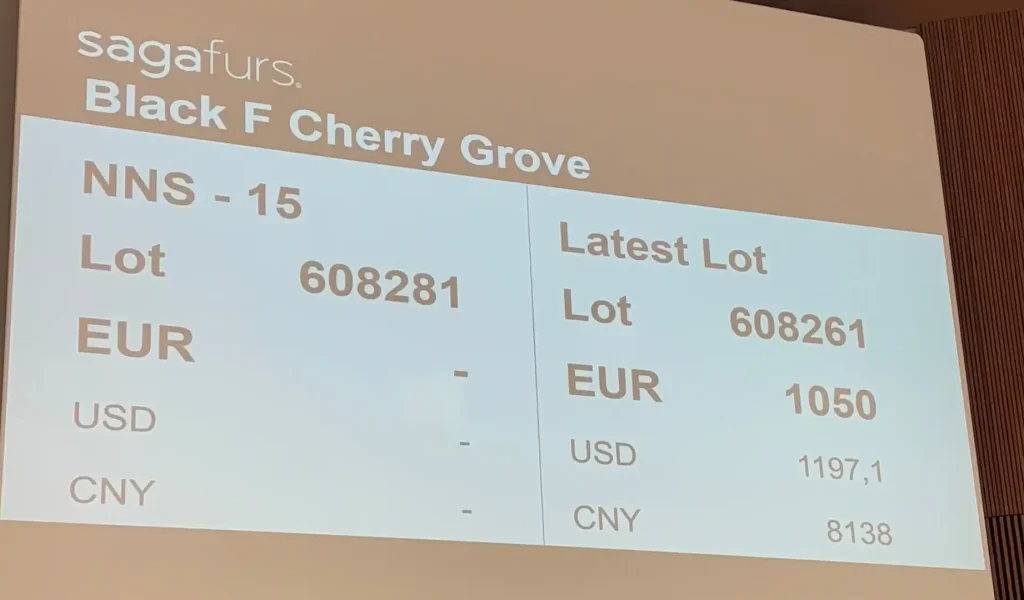
Every lot sold at a major fur auction, SagaFurs, SOBOL, and the other houses, carries a minimum reserve price set by the auctioneer. If bidding on a lot does not reach that minimum, the lot is not sold. It is withheld and carried forward to the next auction cycle, where it will be offered again at the same or an adjusted reserve.
This mechanism protects the market from distressed selling. Auctioneers do not release material at any price, they enforce a floor below which product simply does not move.
What we are observing right now is that the reserve prices being set across all major auction houses are significantly higher than they were a year ago. The floor has moved up, and it is being held firmly. Lots that do not attract bids at the new minimum are being withheld rather than discounted. Buyers who are unwilling to meet the current price level are finding that the material simply is not available to them.
The reserve price mechanism means that fur garment prices are not just a reflection of what buyers want to pay, they are anchored to a floor that the supply side controls. That floor is currently elevated and showing no sign of softening.
What Would Need to Happen for Prices to Fall
A return to last year’s fur garment price levels is not impossible, but it would require a specific and unlikely combination of conditions to occur at the same time.
The first condition is sustained buyer unwillingness. If enough buyers at the auction level consistently refuse to bid at current reserve prices, across multiple auction cycles, the accumulated unsold inventory eventually creates pressure to lower the floor. One or two slow auctions are not sufficient; the refusal would need to be broad and persistent.
The second condition is that this buyer pressure must force the auctioneers themselves to revise their reserve structures downward. Auction houses will defend their floors for as long as the economics of withholding lot inventory allow. That defence can hold for a long time, particularly when farmers and producers are finally profitable again and have less incentive to accept low prices than they did a year ago.
Both conditions working together, over an extended period, could eventually bring fur garment prices lower. But there is no current evidence that either condition is developing at the scale required, let alone both simultaneously.
Last year’s low prices were the product of years of genuine distress, oversupply, below-cost farming, and a market with no floor. That distress has cleared. Recreating those conditions would require an entirely new set of market failures, none of which are currently visible.
What This Means for Buyers Today
The honest answer to the question “should I wait?” is that waiting carries its own risk. The conditions that produced last year’s low fur garment prices were extraordinary, the result of a decade of market distress that ended in a sharp correction. Those conditions are not the baseline. They were the anomaly.
Current prices, while higher than last year, reflect a market that has returned to sustainable levels, where farmers are viable, auctioneers are holding their floors, and demand is broad enough to support those floors through multiple auction cycles.
At J&A, we price our garments transparently, reflecting the real cost of certified, ethically sourced material. We are not in the business of inflating margins on the back of market recovery; our commitment is to offer the best quality available at a fair price, with full documentation of what you are buying and where it came from.
Our Honest Assessment
A return to last year’s prices is possible, but not imminent. The auction reserve price structure currently in place across all major houses is elevated and holding, and the conditions required to force it lower are not present in the market today.
Waiting is a personal decision, but it carries a cost. Every season that passes without a purchase is a season without the piece you want. If the price environment does not materially improve, and the structural evidence suggests it will not soon, waiting simply defers enjoyment rather than delivering a better outcome.
Buy with your eyes open, not with false hope. Understand the current fur garment price environment for what it is: a recovered, healthy market, not an artificially inflated one. That is the context in which a good purchase decision makes sense.
At J&A International, we offer full transparency on pricing and sourcing; every garment reflects the true cost of certified, ethically sourced materials, with FURMARK, SOBOL, SagaFurs, and CITES documentation to back it up. If you are weighing a purchase decision and want an honest conversation about the market, our Hong Kong team is here. Visit j-a-international.com to explore the collection.