Almost every major fur type has found a path to farming. Lynx cat has not, and it never will. That single fact is what makes its price floor permanent.
3 min read | Lynx Cat | Market Analysis | Fur Industry
Article Summary
In the fur industry, nearly every major fur type, including mink, sable, and chinchilla, can be raised in a farm environment, and farming has driven meaningful innovation in both quality and supply over time. That trajectory is simply not available to lynx cat, and it never will be.
Lynx cat is an inherently wild, solitary, and highly agile animal. It cannot be raised in groups, cannot be contained effectively, and does not thrive outside of a natural habitat. Farming is not a future possibility; it is a permanent impossibility. That is exactly why lynx cat supply will always remain genuinely limited, and why its price will never experience the kind of correction that farming-driven oversupply can bring to other fur types.
Farmable Fur Types
Mink · Chinchilla · Sable
- Can be raised in controlled environments
- Quality and quantity improving through innovation
- Supply can respond to demand over time
Lynx Cat
Wild Only, Always
- Aggressive and solitary, cannot be grouped
- Agility makes containment impossible
- Supply permanently capped by nature
Farming Has Transformed Most of the Fur Industry
The ability to farm fur animals has been one of the most significant forces shaping the modern fur industry. Mink and chinchilla farming in particular have seen meaningful advances in both the quality of the animal and the efficiency of production, which has helped supply keep pace with growing demand over the years. Read more in wild fur vs farm fur.
Sable farming, while more limited, has also made progress. For most major fur types, farming represents a lever that producers can pull when prices rise high enough to justify expanding capacity. Lynx cat has no such lever, and that difference matters enormously.
Why Lynx Cat Cannot Be Farmed
Lynx cat is a solitary and highly aggressive animal by nature. Like saltwater crocodiles, lynx cat cannot be raised in group environments. The animals simply will not tolerate proximity to one another, which makes any conventional farming setup immediately unworkable.
Beyond the aggression problem, lynx cat is also an exceptionally agile animal. Containment that would be sufficient for other species is not sufficient for lynx cat, adding another layer of practical impossibility to any farming attempt.
Farming an animal is not purely a question of resources or technology. It is a question of whether the animal’s nature permits it. For lynx cat, the answer is no, and that answer is permanent.
Animal Wellbeing Is Part of the Equation
Raising an animal responsibly is not only about feeding it and keeping it alive. It also means considering whether the environment meets the animal’s genuine needs. Lynx cat is a species that requires the freedom and complexity of a wild habitat to live well.
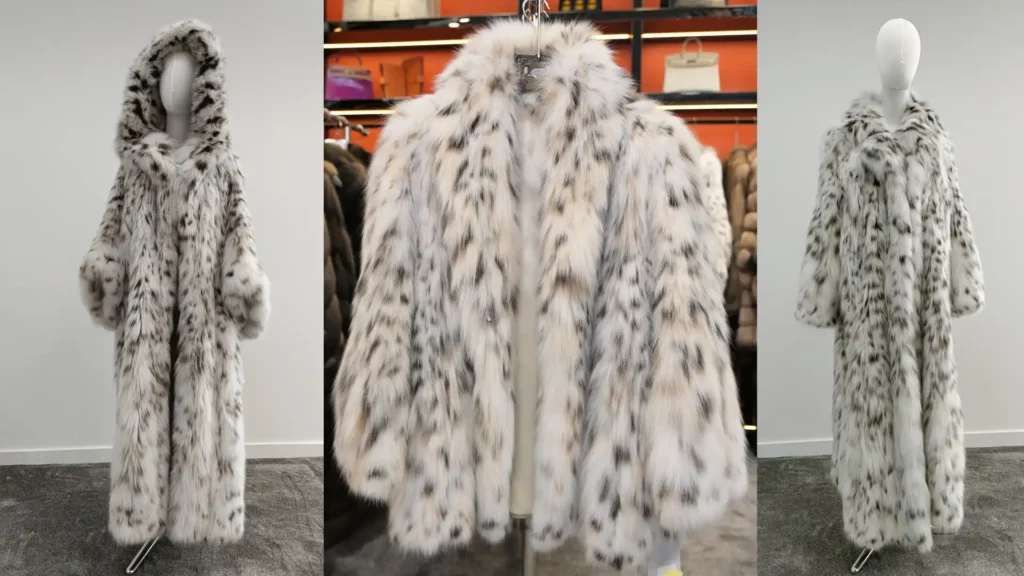
Placing lynx cat in a captive farming environment would cause real harm to the animal’s wellbeing, which is something J&A International is not willing to be part of. Every lynx cat coat we carry holds a CITES certification, reflecting our commitment to sourcing only within the boundaries of responsible, regulated supply.
What This Means for Lynx Cat Pricing
Because lynx cat supply is permanently capped by the animal’s own nature, the price dynamics that affect farmable fur types simply do not apply here. There is no scenario in which a surge in farming production floods the market with lynx cat pelts and drives prices down. That mechanism does not exist for this fur.
Demand for lynx cat can rise, fall, or shift in character, but supply will always be constrained in a way that gives the material a natural price floor. That floor is structural, not cyclical, and it is one of the core reasons lynx cat remains among the most enduring luxury furs in the world. For more on value, see what makes a lynx cat coat so expensive.
Why Lynx Cat Pricing Has a Permanent Floor
Farming is not a future option; it is an impossibility. Lynx cat’s aggression, solitary nature, and agility make captive production fundamentally unworkable.
Supply will always be capped by nature. No amount of demand or investment can expand lynx cat supply beyond what the wild sustainably provides under regulated harvesting.
The result is structural scarcity. Unlike farmable fur types, lynx cat will never experience a supply-driven price crash. Its exclusivity is built into the animal itself.
Interested in a lynx cat coat with full CITES certification? Contact J&A International to learn more about our collection and our commitment to responsible, ethically sourced luxury fur.